The God of the Gaps: Understanding Science Through the Lens of Religion and Politics by Zahra Mesrizadeh
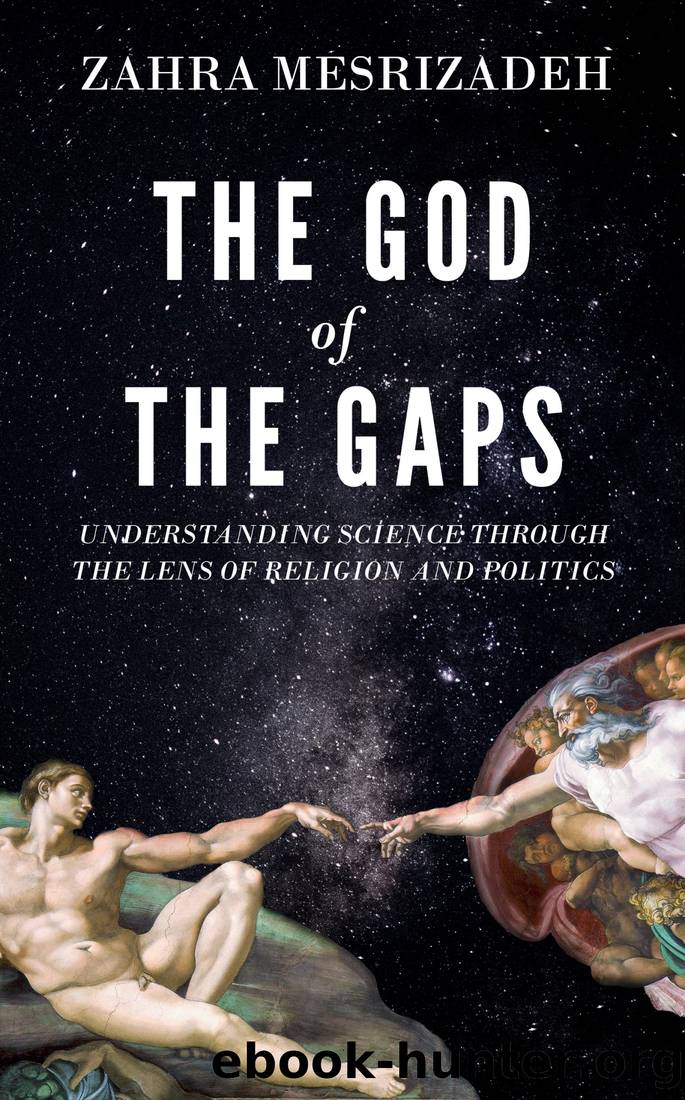
Author:Zahra Mesrizadeh [Mesrizadeh, Zahra]
Language: eng
Format: epub
ISBN: 9781636768021
Google: E81XzgEACAAJ
Amazon: B0949TTC1G
Goodreads: 58060935
Publisher: New Degree Press
Published: 2021-04-26T09:40:39+00:00
The Role of Technology in Spreading Irrationality
Social media and its built-in algorithms have been a main topic of debate, and in recent years, ethics committees have been involved to unveil a solution for the spread of irrational ideologies. Social media algorithms were not necessarily designed to take advantage of peopleâs biases, but the algorithm was an invention of humans, so human flaws will follow as we use it. This is important to take into account when debating whether social media was intentionally built to misguide or not. The inherent cognitive biases in being human needs to be taken into consideration, and we need to accept the reality of our limitations.
Technologies such as social media have created a great platform that bring together people all over the world at the tap of a finger. For instance, in the current circumstances, the COVID-19 pandemic, the majority of people have been staying at home for months. Some are living alone. Due to social media, we all can grab our devices and join an online book club, attend cooking workshops, learn new skills in Masterclasses, and (my favorite) attend scientific workshops held by institutions and scientists across the United States and beyond. Letâs imagine that we did not have such a tool as the internet to spend our free time in. What if it was during the 1918 Spanish flu, and we were just sitting in our homes with very limited social connections? Not everyone is a Shakespeare who would write a play while isolated during the plague. A more recent reference would be Taylor Swift, who produced two albums during the COVID-19 pandemic. We need to be more realistic when it comes to new technologies to consider what are the advantages and disadvantages it brings to our lives. As humans are a spectrum of emotions walking around, new technologies are also a spectrum of data that learns and reprograms based on your emotions. As Yuval Noah Harari in his book 21 Lessons for the 21st Century, describes â[i]t turned out that our choices of everything from food to mates result not from some mysterious free will, but rather from billions of neurons calculating probabilities within a split second.â121
The analogy that I would use is to think of social media like a child because similar to social media children are the product of their environment. If a child is being rude or acting out, it would be logical to assume the childâs parent has responsibility in their childâs behavior. Social media is the product of humans, and we are responsible for bringing our own biases and flaws into it. Just as social media algorithms cater to people and shine the light on human biases, so do politics and religion. As this book is covering various aspects of a humanâs role in society, this is another example of cognitive biases into our daily lives.
There are cultural beliefs, such as the fear of the number thirteen, that do not have a significant impact on peopleâs lives. However, there are collective beliefs that can be harmful.
Download
This site does not store any files on its server. We only index and link to content provided by other sites. Please contact the content providers to delete copyright contents if any and email us, we'll remove relevant links or contents immediately.
The Thirst by Nesbo Jo(7006)
Permanent Record by Edward Snowden(5893)
The Myth of the Strong Leader by Archie Brown(5552)
Spare by Prince Harry The Duke of Sussex(5262)
A Higher Loyalty: Truth, Lies, and Leadership by James Comey(5018)
Secrecy World by Jake Bernstein(4800)
Adulting by Kelly Williams Brown(4623)
The Borden Murders by Sarah Miller(4382)
Machine Learning at Scale with H2O by Gregory Keys | David Whiting(4365)
Killers of the Flower Moon by David Grann(4114)
American Kingpin by Nick Bilton(3932)
The Secret Barrister by The Secret Barrister(3757)
Fear by Bob Woodward(3723)
Future Crimes by Marc Goodman(3630)
The Last Girl by Nadia Murad(3549)
The House on Mango Street by Sandra Cisneros(3512)
Liar's Poker by Michael Lewis(3491)
Oathbringer (The Stormlight Archive, Book 3) by Brandon Sanderson(3317)
The Social Psychology of Inequality by Unknown(3089)
